Joe Cronin: the quiet architect of Portland's reset
Cronin inherited a broken organization, a demanding star, and no first-round picks through 2028. He executed a masterful Lillard exit and is now managing a Phase 1 rebuild. The key question: is Scoot Henderson the cornerstone?
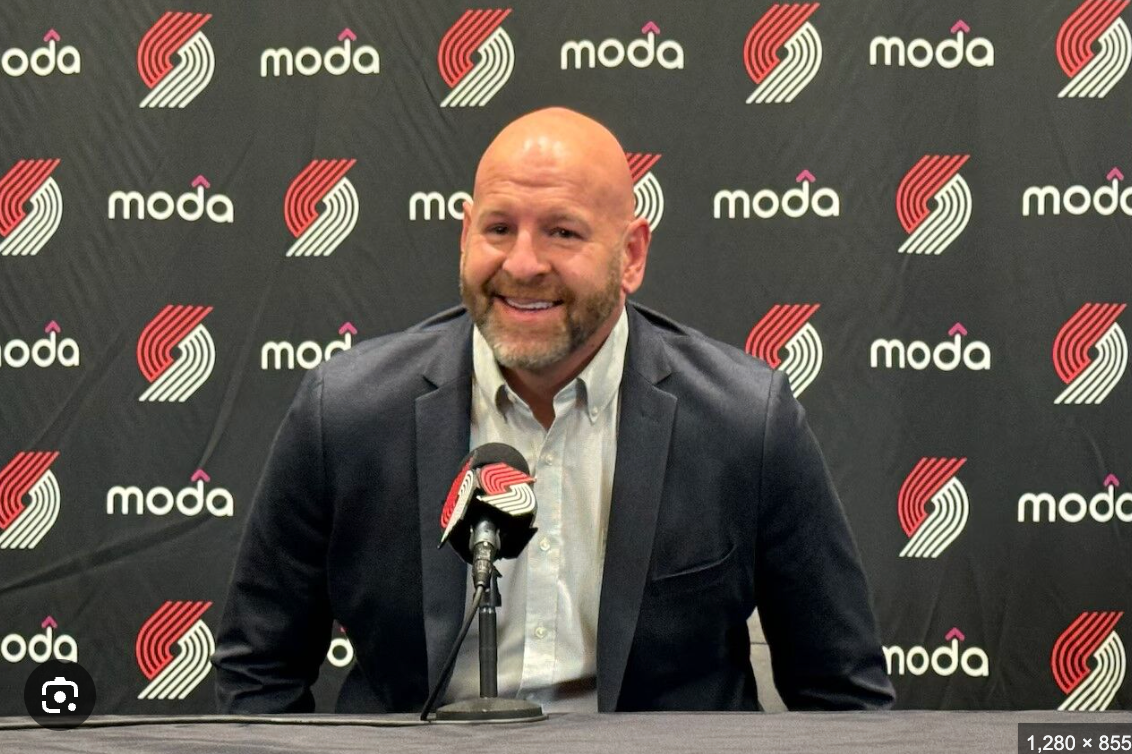
Joe Cronin has spent his entire professional life in one building. Seventeen years as an intern, scout, cap analyst, director of player personnel, and assistant GM before taking the chair in December 2021 under circumstances nobody would have chosen.
He is Portland's 11th GM in franchise history and the first to come entirely from within the organization. No other team. No other front office. Just one city, one uniform, and a master's degree from the University of Denver earned while working as a graduate assistant for their men's basketball program.
His sister Katie played in the WNBA. He grew up in Denver, attended the Air Force Academy Preparatory School before pivoting to basketball at Regis University and then the University of Northern Colorado. He is not a media personality, not a big-market power broker, not a former player. He is a cap analyst who became a GM by being the most qualified person in the building when the building caught fire.
Who He Replaced — And Why
Neil Olshey had run Portland's front office since 2012. He drafted Damian Lillard sixth overall that year, built the team around him, and delivered eight consecutive playoff appearances. By conventional metrics he was successful. By cultural metrics he was a disaster.
In November 2021, the franchise hired the law firm O'Melveny & Myers to investigate complaints from non-player personnel about the workplace environment. Four weeks later Olshey was fired. The team's statement was terse: he had violated the Portland Trail Blazers' Code of Conduct.
What followed was damning. Staff had been subjected to intimidation, profanity-laced tirades, and bullying tactics. Barry Hecker, who had worked with Olshey at the Clippers, told The Oregonian's John Canzano: "He has no idea how to treat people. He's an arrogant SOB." CEO Chris McGowan had already resigned weeks earlier.
When Cronin stepped in on December 3, 2021, he wasn't just replacing a fired GM. He was inheriting the wreckage of an organizational collapse. The team was 11-16. Lillard was recovering from abdominal surgery. The roster was imbalanced. The culture was broken. Portland's first-round pick was locked to Chicago through 2028. Ownership — the Paul Allen Family Trust, steered by Jody Allen and Bert Kolde — was rudderless.
The initial coverage framed him as a placeholder. He was described as a safe internal candidate who knew the operation but had never run one. The franchise announced it would conduct a search for a permanent replacement. That search produced Cronin.
2022 — Playing Two Strategies at Once
Cronin's first year is the most analytically interesting period of his tenure because he was simultaneously executing two strategies that pulled in opposite directions.
Publicly: building a contender around Lillard. Every press conference, every statement, every move was framed through that lens. Jody Allen released a statement in July 2022 declaring the franchise's focus was "on winning." Lillard was evaluating the organization's commitment before agreeing to his own extension.
Privately: beginning the asset conversion that would eventually become a full Phase 1 reset. The Powell/Covington salary dump reset the repeater tax clock. The McCollum trade — which Olshey had refused to make for years — converted an aging backcourt partner into younger, more versatile pieces and a $21 million trade exception sized precisely to fit Jerami Grant's salary. The Shaedon Sharpe pick at #7 — a player with zero competitive minutes at any level — was a Phase 1 swing for a cornerstone, not a Phase 3 fill for an existing roster need.
He couldn't declare a rebuild while Lillard was there. Ownership wasn't ready. Lillard's $122 million extension was contingent on seeing contention commitment. The Simons and Nurkic extensions that summer were the price of Lillard's signature — a price Cronin paid because without Lillard's extension, Portland gets nothing when he eventually requests a trade.
His own words from that period give it away: "I don't have massive expectations as to 'Hey, this team needs to make this benchmark.' I want to see them play the style of basketball we're trying to build here — be extremely competitive, be really defensive minded, play together. I think our talent base if we do those things will take us to pretty good levels and then we gotta keep building from there."
That's not a GM who thinks he has a championship roster. That's a GM threading a needle between what he knows and what he can say.
The Lillard Trade — Summer 2023
On July 1, 2023, Lillard requested a trade. To Miami and Miami only. Pat Riley offered Tyler Herro and filler. Cronin refused.
The national media spent the entire summer calling him obstinate, naïve, and out of his depth. ESPN ran takes about Portland's leverage being zero. Analysts said he had no choice but to capitulate. He told reporters in Las Vegas: "Patience is critical. Don't be reactive, don't jump at things just to solve a problem."
He held firm through an entire summer of public pressure, a Lillard showing up at the practice facility, a league-mediated meeting, and a reported request from Lillard in early September to rescind his trade request and return to the team. Cronin's response: there was no coming back. Lillard was shocked.
Jody Allen had reached the same conclusion. In a Zoom call with staff in early September, she said simply: "We really need to move on."
The eventual deal: Lillard to Milwaukee. Portland received Jrue Holiday, Deandre Ayton, Toumani Camara, and three first-round picks and swaps. Then the next morning Cronin flipped Holiday to Boston for Malcolm Brogdon, Robert Williams, a 2024 first-round pick, and a 2029 first-round pick.
Two days. Two trades. A haul that transformed Portland's asset base. The national media that had spent three months criticizing him reversed course immediately. Lillard's goodbye letter to Portland notably omitted Cronin's name.
Phase Assessment — Where He Actually Stands
Cronin's tenure divides cleanly into two chapters with a hard line drawn in September 2023.
Chapter one was constraint management — a new GM with no real authority, an inherited star, an ownership group not ready for a rebuild, and a public narrative that required him to perform Phase 3 while privately executing Phase 1. The moves he made under those constraints — the McCollum trade, the Sharpe pick, the cap restructuring — were analytically correct even when publicly dressed as something else.
Chapter two is the rebuild itself. The Lillard trade haul is the foundation. Henderson at #3 and Clingan at #7 are the draft anchors. Avdija, acquired in 2024, is the best value trade of his tenure. The roster has improved from projected 21-win lottery team to legitimate play-in contender in two seasons.
The one clear failure of his tenure is the Jerami Grant extension — five years, $160 million, signed simultaneously with Lillard's trade request in the summer of 2023. Grant is a good player on an expensive contract on a rebuilding team. Cronin himself has acknowledged the difficulty of that decision, arguing Grant was too good to let walk for nothing. The argument is understandable. The price was still too high.
The unresolved question that defines everything going forward: is Scoot Henderson actually the cornerstone? Henderson has shown playmaking vision and speed but has not yet established himself as a franchise-defining talent. Portland's entire timeline — when they exit Phase 1, when they can credibly begin Phase 2 Construction — depends on the answer.
The Extension and What It Means
On April 7, 2025, under new owner Tom Dundon, Cronin signed a multi-year extension. The Dundon era represents a clean break from the ambiguity of the Jody Allen years — a real owner with real basketball investment and a clear mandate.
Cronin told Willamette Week: "I'm so focused on just doing a great job, for as long as I have it, that that's all I really lock in on."
Seventeen years in one building. A fired boss, a broken culture, a demanding star, a skeptical media, and a summer of national criticism. He held the line on the Lillard trade, extracted maximum value, and is now managing the rebuild he always privately knew was coming.
CBS Sports ranked him 19th among front office executives in February 2026. That ranking will move significantly — up or down — depending on what Scoot Henderson becomes.